Physics | Data Science | AI
Data-Driven Science
For Social & Environmental Good
Intro to me
Hello there! I am a Lecturer in Physics at Universidad de Costa Rica. My research and teaching focuses on interdisciplinary AI applications to physics, ecology and fishery science. Through my lectures I seek to give students practical experience with tools from data science, classical machine learning and deep learning, which find increasing applications in science.
After working on theoretical quantum computing during my PhD at the University of Cologne, Germany, my research interests shifted towards more applied and interdisciplinary topics. My driving question throughout this process has been how can a mathy guy like me have a positive impact on the world?
This motivating principle led me to work as a postdoc UC Berkeley’s Schmidt Center for Data Science & the Environment, and the Department of Enviornmental Science, Policy and Management. There I led the establishment of a research program at the intersection of data science, machine learning and quantitative ecology.
Open to work. I am now excited to transition from academia to the industry as a data scientist or machine learning engineer. I am interested in on-site, hybrid and remote options in Costa Rica, Spain and Italy.
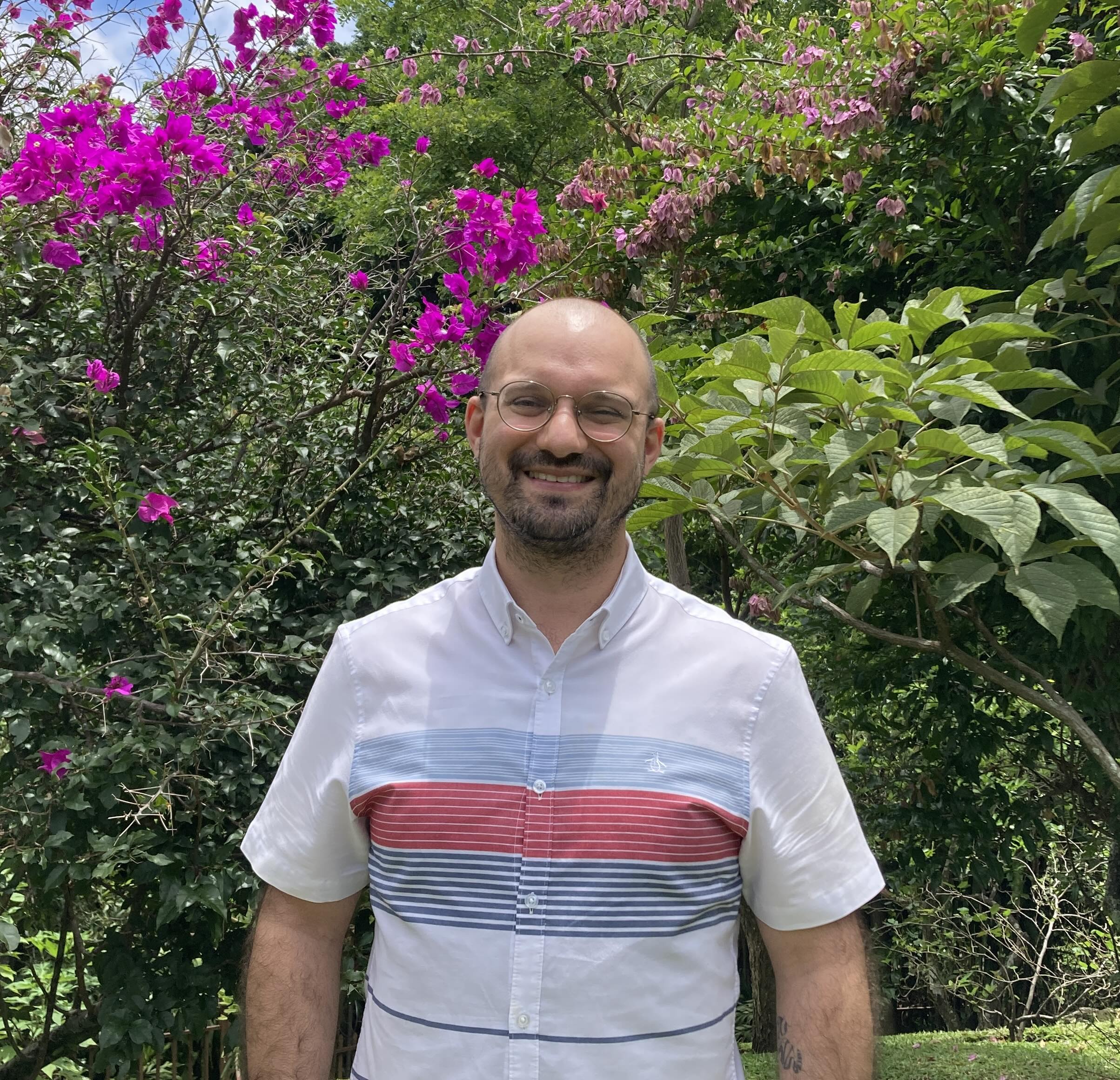
Me in a beautiful garden!
Programming foundations
Python (expert), R (advanced), SQL (DuckDB, PostgreSQL), C++, MatLAB
Modeling & Optimization
PyTorch, Scikit-learn, Darts, OpenAI Gymnasium, Stable Baselines, Ray/RLlib, Optuna, Scikit-optimize, CVXPY
Data and scientific computing
NumPy, Pandas, SciPy, Distributed computing (Ray, PySpark) Geospatial data processing (xarray, geopandas, pystac, odc-stac, rasterio/rioxarray), ibis, tidyverse, NetworkX
Production and engineering
Git, pytest, CI/CD (GitHub Actions, GitLab Workflows), Docker, uv, pyenv, Amazon Athena / S3 / SageMaker, IaC (Terraform)
Visualization and communication
Matplotlib, Seaborn, Plotly, ggplot2, Plotnine
Statistical modeling & inference
R-nimble (Bayesian modeling, MCMC), PyMC (MCMC)
Through my research projects and teaching I’ve focused on bringing modern software development practices to academic work, promoting the reproducibility and reusability of my work. Here I summarize my software and data-related skills I have gained with this approach.
Reinforcement learning. I’ve extensively worked in developing reinforcement learning approaches in environmental science contexts such as fishery management, invasive species management, caribou conservation, and dynamical multispecies stabilization. Throughout this work I have become experienced with building custom neural network models in PyTorch, training feed-forward and recurrent networks and generating CI/CD pipelines for unit testing. I moreover am leading the creation of an SQL database to enhance the reproducibility of our team’s fishery RL work.
Statistical inference, fullstack development. Through my collaboration with Karuk wildlife managers and researchers, I have become experienced in statistical inference pipelines in R and Python, as well as in the deployment of graphical apps through GitHub Actions, and in setting up computer vision tools for wildlife monitoring. In this project I pivoted from creating code internally within my research team to developing a backend and frontend for an external stakeholder. The code repositories are private to protect indigenous data sovereignty, however our first paper is published here! There, we used Bayesian hierarchical modelling and MCMC to infer accurate estimates of the abundance and homerange of elk in the study area using community observational data.
Cloud-native geospatial data processing. For a few months I contributed to a project developing a quantitative geospatial approach to environmental justice. Geospatial data is typically large and thus hosted in the cloud, usually in AWS S3 buckets, thus quantitative geospatial analyses are more naturally suited to cloud-native approaches even though they are commonly implemented locally in academic work. This project seeked to close this gap, providing tutorials of how to efficiently process geospatial data in environmental research contexts in a cloud-native manner. To maximize the reproducibility of this work, we containerized our pipeline.
ML in teaching. In teaching the Advanced computational physics lecture at UCR, I have become experienced with a variety of ML algorithms which, while they were adjacent to my work, had not shown up in my research projects. For example I have become experienced in setting up practical workshops on using SciKit-Learn, SciKit-Optimize and PyTorch to run ML classification tasks, logistic regression, ridge regression, support vector machine optimization, k-means clustering, and semi-definite programming optimization.
Data visualization. Given that I am a mathy guy who works with both physicists and biological scientists, it has been crucial for me to provide informative and actionable data visualizations every step of the way in my collaborations. I believe that data visualization is the ground on which one can build successful, cross-functional collaborations.
Additional tools. I also use agentic AI tools to support software development: this website was deployed with the Copilot CLI, which I have also used to debug and optimize an ongoing reinforcement learning project.
Mentoring
Mentoring is an important aspect of my professional profile. Knowledge sharing is powerful in industry and academia, and good mentoring can vitalize teams’ productivity, especially in cross-functional and interdisciplinary teams. These are the research projects I have had the priviledge of mentoring:
- Kendall Salazar, U of Costa Rica. Research project on RL for multi-species Lotka-Volterra harvesting problems.
- Aaron Sanabria, U of Costa Rica. Research project on MCMC and statistical estimation for heavy-ion collision data.
- Maxwell Tanguchi-King, UC Berkeley. Internship on software development and indigenous data sovereignty in biodiversity monitoring.
- Nithya Appannagaari, UC Berkeley. Internship on software development and indigenous data sovereignty in biodiversity monitoring.
- Claire Liu, UC Berkeley. B.Sc. thesis on predictability of extreme rain events in the SF Bay Area. Undergrad research assistantship on RL approaches to partially observable population dynamics control problems.
- Maya Nalliah, UC Berkeley. Undergrad research assistantship on RL approaches to highly stochastic and non-stationary population dynamics control problems.
- Felix Hoeddinghaus, U of Cologne. B.Sc. thesis on discrete algebraic groups arising in a quantum computing context.
- Angelos Bampounis, U of Cologne. M.Sc. thesis on representation theory of the single-qubit Clifford group.
- Paula Belzig, U of Cologne & ETH Zurich. M.Sc. thesis on the Stabilizer de Finetti theorem and applications to quantum communication.
- Tobias Hartmann, U of Cologne. B.Sc. thesis on state-independent contextuality for few-qubit systems.
- Stefan Schmit, U of Cologne. B.Sc. thesis on parametric noise on quantum control problems.
Research
My research line uses a variety of deep learning, data science and applied statistics to address hard scientific questions.
03
AI-enhanced ecology
How can ecologists effectively and safely use AI-powered tools to provide data-driven support on conservation decisions? Particularly, this project addresses the question in the context of indigenous data sovereignty.
04
Clifford group representations
The Clifford group is an immensely important mathematical object in quantum computing. Understanding its representation theory can unlock applications across the board, from quantum device characterization to novel quantum protocols. In this project I have led the development of several approaches to characterize this representation theory.
I’m also dabbling in other projects like on statistical inference for heavy ion collision experiments with my close friend and collaborator Oscar García. Similarly, I occasionally enjoy contributing to the open source ecosystem on, e.g., MyST or improving the experience of other lecturers in generating useful class list documents.
Publications
Selected publications and works in progress. For a complete list, please visit my Google Scholar profile.
F. Montealegre-Mora, C. Cahill, C. Walters, C. Boettiger. (2025) Using machine learning to inform harvest control rule design in complex fishery settings. Fish and Fisheries.
T. Connor, F. Montealegre-Mora, B.J. Saxon, J. Camarena, D. Sarna-Wijcicki, M. de Bruyn, K.L. Calhoun, C.C. Martinez, E. Tripp. (2025). Indigenous Knowledge and Community‐Derived Counts Produce Robust Wildlife Population Estimates: Roosevelt Elk in Karuk Aboriginal Territory. Ecology & Evolution.
F. Montealegre-Mora, D. Gross. (2025) Duality theory for Clifford tensor powers. J. Mathematical Physics.
F. Montealegre-Mora, M. Lapeyrolerie, M. Chapman, A.G. Keller, C. Boettiger. (2023) Pretty darn good control: when are approximate solutions better than approximate models. Bulletin of Mathematical Biology.
D. Ellis-Soto et al. (incl. Montealegre-Mora in core organizing team). (2026) Aligning biodiversity AI with social, historical, and governance dimensions is critical for conservation science. Submitted to One Earth.
Teaching
Courses
Advanced computational physics / II-2026 / Numerical spectral analysis for PDEs, Optimization algorithms, Machine learning and deep learning. For advanced physics undergrads
Algorithmic textual analysis / II-2026 / Introduction to statistical and deep learning approaches for textual and sentiment analysis. For professional social scientists.
Tropical Fishery Science and Management / II-2026 / Co-lecturer teaching stock assessment statistical modelling and ML methods in fishery science. For grad students in the GIACT master’s degree.
General Physics I & II / II-2026 / Lectures for first and second year engineering undergrads covering introductory mechanics, fluid dynamics, wave mechanics, thermodynamics and electrostatics.
Music
Besides my academic work, I love playing music! Here I’ll post songs from several of my musical projects.